Church House CEO Jeremy Wharton gives his latest expert commentary on interest rates and global credit markets.
Geopolitics continue to dominate as US/Iran ceasefires are implemented and then broken. After trading to headlines initially, credit markets have latterly largely ignored developments and are trading well as liquidity remains ample.
We have seen plenty of Central Bank focus. Jerome Powell stepped down as Chairman of the Federal Reserve with all the grace he has managed to maintain in the face of some withering personal attacks, and he stays as a voting Governor on the FOMC. The economic situation ‘sock-puppet’ Kevin Warsh has inherited is not one he would have chosen if he is to fulfil his master’s desire to slash rates. A strong economy with rising inflation does not facilitate that.
Chairman Warsh’s first FOMC meeting was perceived to be more hawkish than expected as he emphasized the inflation-fighting credibility of the Fed. He views current monetary policy as restrictive on housing but not inflation. He emphasized his ambition to reform the Fed and initially this consists of setting up several ‘task forces’, reviewing balance sheet policy and doing away with forward guidance. The ‘dot plot’ looks to be doomed and without any kind of indication from the Central Bank we can look forward to markets misreading future moves and the potential for more volatility.
The percentage of short-term T-Bills as a share of gross US Treasury issuance now stands at 85%, a two-decade high. This means that Fed policy has an amplified effect on funding costs as they control the front end of the curve. A hike by the Fed is priced in for the second half of 2026 helped by a blowout payrolls gain. US Treasuries have mostly seen rising yields and ‘bear steepening’, where long dated yields rise faster than shorter yields. With the ten-year Treasury yield through 4.5% and the Long Bond well over 5%, the costs of servicing the US debt mountain are rising.
Japan is suffering a high inflation environment like everyone else and the BoJ recently hiked rates to a thirty-one-year high (still only 1%), which has implications for the ‘carry trade’ (where investors borrow cheaply in Japan to invest in US assets) and therefore US Treasury demand.
The European Central Bank delivered a precautionary hike of 25bp. Valdis Dombrovskis, the EU’s economy chief, reiterated that the ECB must act to counter the effects of inflationary pressures pushing up prices as a result of the war. He and fellow ministers can’t make the independent ECB do their bidding, but it doesn’t stop them applying pressure. President Lagarde said that while this ‘inflation shock’ warranted a hike, second round effects have not yet materialised, so the ECB remains in active wait and see mode. Maybe it will be one and done for the moment if inflation expectations remain anchored.
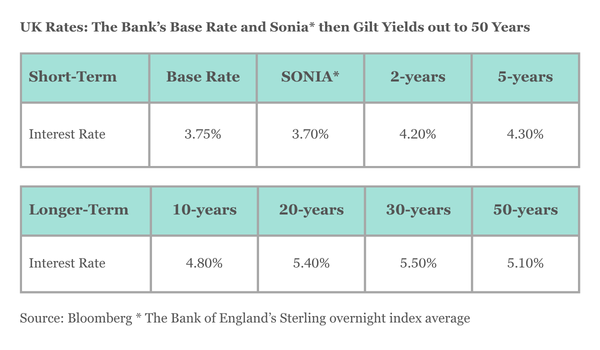
Inflation worries and political uncertainty helped long-dated Gilt yields to return briefly to 1998 levels in May and they have bounced around at elevated levels since. The Gilt yield curve has moved as a whole and while it is pointed out at every opportunity that we have the highest rates in the G7, we have actually moved pretty much in line with others. Weak jobs data and wage growth ensure that the Bank remains in a bind, and they will be unwilling to hike rates. They stayed put at a recent meeting and although UK money markets have moved away from the extremes first seen when the war started, they still move between discounting one or two hikes. UK inflation was lower than expectations at 2.8% in May.
Political risk reasserted itself with PM Starmer setting out a September timetable for his departure after Andy Burnham’s sweeping by-election victory caused his Cabinet support to evaporate. Despite his recent protestations, we have a potential future PM who does not respect bond markets and Gilts have seen some extra volatility which may continue. National debt will soon pass £3tn. Sterling credit spreads remain well supported by demand and they have returned to levels last seen before the war.
Primary markets continue to run at high capacity. Forecast ‘hyperscaler’ (Google, Microsoft et al) investment has increased to $750bn in 2026, with a significant chunk coming from capital markets and there is the possibility of indigestion at some point. However, not so far, with strong books for every new issue and precious little New Issue Premium. Hyperscaler issuance dominates and they will access any currency that will have them. Amazon established a Canadian dollar C$14bn curve in a five tranche deal in ‘maple’ bonds. Free cashflow and share buybacks have turned into debt and equity issuance, and the race continues. Nvidia, provider of chips to the hyperscalers and previously the least indebted of the Mag7, issued $25bn in seven tranches that were four times subscribed… to fund share buybacks. These issues have seen strong demand but are all trading poorly in the secondary market.
SpaceX followed its IPO with a $25bn bond issue, which immediately began trading at the weakest levels credit markets have seen for years. Oracle, who have completely turned their balance sheet multiples upside down, have just been downgraded to BBB- i.e. on the cusp of junk status.
The full Quarterly Review is available here.
July 2026
Important Information
The contents of this article are for information purposes only and do not constitute advice or a personal recommendation. Investors are advised to seek professional advice before entering into any investment arrangements.
Please also note the value of investments and the income you get from them may fall as well as rise, and there is no certainty that you will get back the amount of your original investment. You should also be aware that past performance may not be a reliable guide to future performance.
How would you like to share this?