An often overlooked alternative to cash deposits with significant appeal for higher earners
Many of the people we speak to are holding more cash on deposit than they need. Some are wary of investing while markets feel unsettled; others are setting money aside for a known liability in months ahead. With interest rates rising again, a fixed-rate account at the bank might seem the sensible place for it. Yet for higher and additional-rate taxpayers, it is one of the least tax-efficient homes for money. A quietly effective and often overlooked alternative is the humble gilt.
A Familiar Conversation
Consider an illustrative couple in their fifties. They have recently sold a property and have £500,000 sitting in a fixed savings account paying 4.50% annually, a standard rate currently being offered by most high street banks. Their ISAs are full, their pensions topped up, and both are higher-rate taxpayers. On paper, 4.50% feels like a good result.
After tax at 40%, however, it is paying closer to 2.70%. From April 2027, when the tax on savings interest rises to 44% following October's Budget, it falls to around 2.52%. With CPI currently at 3.60%, in real terms this cash deposit is losing money.
Now consider a fixed term gilt, which, put simply, is a loan issued by the UK government. It pays a fixed rate of interest, known as the “coupon”, and repays its £100 par value (the “principal”) on a fixed date, regardless of the price you paid for it. Because interest rates have risen, many low-coupon gilts now trade below £100. The UK Treasury 0.125% 31st January 2028, for example, is priced at around £95.30 at the time of writing, known as trading below the par value. Hold it to maturity and the rise back to £100 is treated as a capital gain, and for individuals and trusts, gains on gilts are free of capital gains tax.* This is the most attractive advantage of investing in gilts. Meanwhile the coupon of 0.125%, which makes up a small amount of the overall return, is taxed at your marginal rate of income tax.
The Arithmetic of Tax
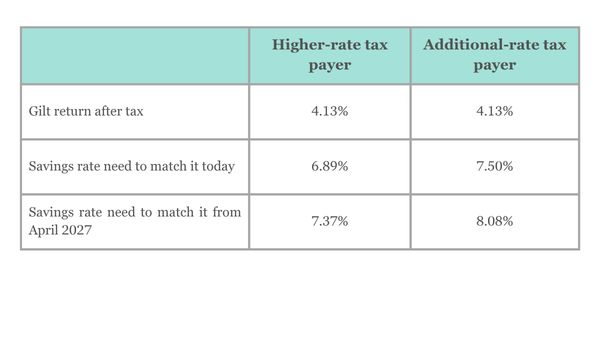
That gilt offers a return of roughly 4.13% a year after tax. To match it, our couple would need a savings account paying 6.89% today, or 7.37% once the new personal taxation rates arrive in 2027. For an additional-rate taxpayer, the figure is over 8.08%.**
On £500,000, that is the difference between around £13,500 a year after tax in the bank versus £20,650 in returns from the gilt. That is approximately £7,150 more per annum from the gilt. An extra £7,150 in your pocket, as opposed to Mr Healey’s… No bank is paying 6.89% on savings. Whilst the gilt in nominal terms does not pay this either, the net equivalent return to achieve the same post tax return result, does.
Planning Rewarded
On 5 November, the Bank of England raised interest rates to 4%, its first increase in more than three years, and markets expect more to follow. That has pushed gilt prices lower, which means today's buyers can fix a known return to maturity, irrespective of what interest rates do next.
The one condition is patience. Gilt prices move day to day, and anyone who sells early must be prepared to receive less than they paid. Especially for those holding longer-dated gilts, who will experience greater volatility. However, for the purposes outlined below, we would only suggest shorter-dated gilts of less than 3 years to maturity, where prices are significantly less volatile and if held to maturity, the outcome is set from the outset.
Money With a Date on It
Gilts come into their own when money has a job to do on a known date: a house purchase completing next spring, school fees due each September, a tax bill to HMRC, or a mortgage fix coming to an end with a lump sum to pay down. Choose a gilt that matures shortly before the money is needed, and the cash arrives on time, with a return fixed from the day you buy.
Several gilts with staggered maturities can go further, releasing money term by term to meet school fees, or year by year to fund planned liabilities. Fittingly, the gilt in our example matures on 31 January 2028, the very day the taxpayer self-assessment deadline falls.
The same thinking serves the professionals who advise our clients. Executors setting money aside for an inheritance tax bill, or trustees planning a future distribution or ten-year charge, can hold that cash in gilts timed to the date, rather than leaving it idle in a deposit account.
The gilt market is huge with over £2.5 trillion invested in UK government bonds. Of that figure, private client investors account for only 0.1% of the market. The opportunity is here. Cash should be a decision, not a default.
If you, a trust in which you are involved, or the clients you advise, are holding more cash than intended, we would be delighted to discuss the gilt opportunities.
Notes:
* Gilt gains are exempt from capital gains tax for UK individuals, trustees and personal representatives. Interest (the coupon) is taxed as income. Companies are taxed differently, and charities do not pay tax on interest, so the advantage does not apply to them in the same way.
** Assumes the Personal Savings Allowance has been used. Based on savings income tax of 40% / 45% today and 44% / 49% from 6 April 2027. Gilt prices, yields and savings rates are correct at the time of writing, change daily and are shown for illustration only. The figures above are gross of any costs associated with the purchase and custody of the gilts.
Important Information
The contents of this article are for information purposes only and do not constitute advice or a personal recommendation. Investors are advised to seek professional advice before entering into any investment arrangements. Please note that we are not tax experts, and you should seek professional advice concerning your personal tax affairs from qualified advisers, such as tax accountants.
Please also note that the value of investments and the income you get from them may fall as well as rise, and there is no certainty that you will get back the amount of your original investment. You should also be aware that past performance may not be a reliable guide to future performance.
How would you like to share this?